
We're getting the estrangement conversation wrong again (it's not the therapists)
Is estrangement the fault of evil therapists intent on tearing families apart? The Wall Street Journal "investigates."

Every few months, there is another think piece, sweeping feature, or primetime special circling around the same theme: estrangement. Rarely is the focus on legitimate reasons why people, usually adult children, estrange: abuse, neglect, major values differences, and rejection.
Instead, the mission of these reports seems to be to argue that estrangement is a recent trend, one fueled by an ever-expanding definition of “trauma,” and—the latest—a secret agenda of therapists to fracture families.
Many prominent therapists and estrangement researchers such as Joshua Coleman and Karl Pillemer focus quite a bit on healing rifts, encouraging parents and children alike to expand their capacity for empathy and listen to each other, even if their memories of events greatly differ. Others—such as Whitney Goodman, Lindsay Gibson—support those frustrated with dysfunctional families or emotionally-immature parents (“support” is not the same as “encouraging estrangement”). Folks like Nedra Glover Tawwab emphasize a grounded, practical approach: determine what you want from the relationship, will/won’t tolerate, and set boundaries, find peace.
What these leading voices show is that there are people with a variety of approaches to addressing estrangement, and there’s a need for all of them. People estrange for many different reasons, and it’s a painful experience for both sides.
But when I see stories like Elizabeth Bernstein’s piece in the Wall Street Journal, titled “Are Therapists to Blame for the Rise of Adults Cutting Off Their Parents?”, I can’t help but feel like the balance of the conversation is off. Bernstein dedicates a single line to estrangement related to abuse, noting that most therapists believe it’s justified, but then shifts to hand-wringing about what’s “abusive enough.”
The article centers around one case study in which a woman cuts off her mother, regrets it, and blames her therapist for speeding her through the decision. Should therapists do this? No. Are there some bad therapists in the world? Surely! But the vast majority that I’ve spoken to throughout my career and reporting on family estrangement have said, repeatedly, that it is the client’s decision of whether or not to estrange and how much. It’s simply not the therapist’s job to make any life decisions for their client. This seems to be pretty common practice.
My question is: Why dedicate this much space to this scenario? Why is so little space spent on estrangement related to serious and widespread problems, like abuse and neglect?
When I do a quick inventory of people I’ve spoken with in my personal and professional life who are estranged, here’s what I come up with:
Dad is committed to a traditional worldview and way of relating where he never needs to change, grow, or adjust—his daughter must (even when that means never bringing her girlfriend home for Christmas because he believes her sexuality is a sin that will send her to hell)
Mom has assaulted her and other family members multiple times and been emotionally abusive her entire life
Extended family uses the n-word (long-term partner is Black)
Sibling has been physically, emotionally, or sexually abusive and family does not believe survivor or has exiled them for causing “drama”
Parent has committed incest and other loved ones do not believe or support the victim
Family member threatened them with a weapon
Family member sexually abused them and their child
Family hid multiple sexual abuse allegations to protect perpetrator
These are…just a few. Literally just the ones that pop into my head.
These cases are not nothing. They’re not rare. And the stakes are high.
For instance: Did you know that half of LGBTQ+ young people are estranged from at least one family member and one-third are not sure their family would accept them if they came out? Those who do experience rejection are eight times more likely to report attempting suicide. I have yet to see WSJ cover it (correct me if I’m wrong), but they have recently covered the pain of estrangement for dads, moms who are done being “doormats,” and estrangement related to politics.
If we actually want to understand why people are becoming estranged, a recent YouGov poll is illuminating: 24% are estranged from a sibling and 16% are estranged from a parent (why we don’t talk about sibling estrangement is yet another thing I’ll explore in the near future).
Why? They tell us! If you glance at the chart, “personality conflicts” seems like a big one, but when you examine other categories, you’ll notice some meaningful overlap.
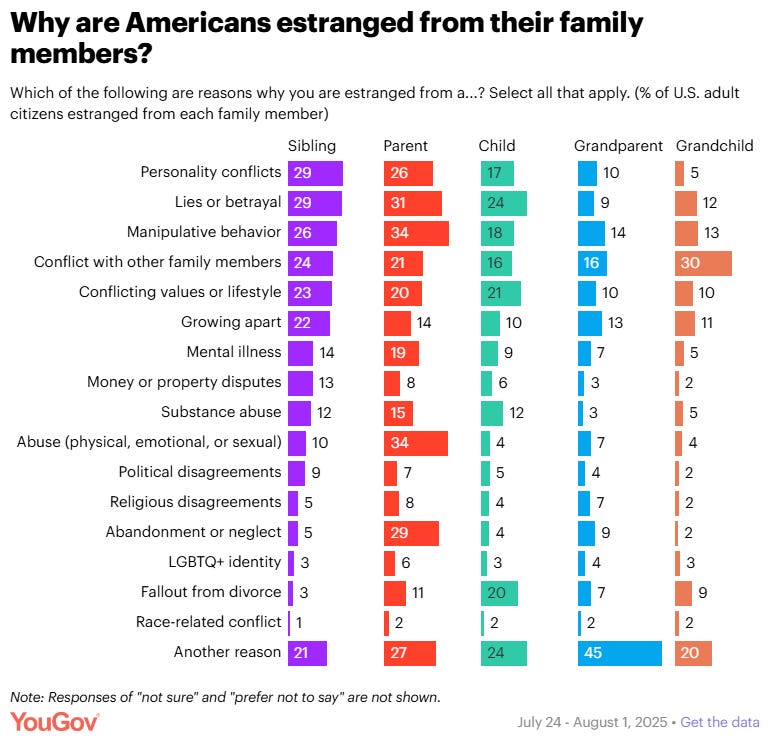
For sibling estrangement, 29% cite lies or betrayal, 26% cite manipulative behavior, 9% cite abuse, 5% cite abandonment or neglect, and 3% cite LGBTQ+ identity. I’d broadly label these categories as falling under “mistreatment” (please tell me: where is the “my therapist told me to” category?).
With parents, the picture is pretty similar: 34% cite abuse, 34% cite manipulative behavior, 31% cite lies or betrayal, 29% cite abandonment or neglect, and 6% cite LGBTQ+ identity. Again, I’d say these broadly fall into the “mistreatment” category.
Conflict is also a large category, one where a therapist could lead a client astray if the emphasis is on distancing over potentially improving communication and conflict negotiation skills. But many other reasons cited are more serious than that and require a different approach, one that often involves self-protection on one end and accountability on the other.
Where are my people who are estranging just because of their therapist? I know none. Haven’t met one.
The stories above, to me, are important. They are real people carrying real grief over the family members they wish they could have and the family they ended up with. Sometimes, the problem is not just a matter of the estranged family member’s sensitivity, Tiktok therapyspeak, or nefarious therapeutic tactics. The problem is their family member. The problem is being mistreated.
It is easy to wave away estrangement as a trend and blame the internet, but LGBTQ+ elders will tell you that being kicked out of your house and relying on chosen family is nothing new. The same is true for victims of incest, whose stories we almost never tell. The hardest task is the most important one: to talk about the reality that the most significant harm comes from within the family, not from outside it.
Is “abuse creep” happening? Is “trauma” being watered down? I’m down to have that debate. I think it’s a worthwhile one. But the estrangement stories I’ve repeatedly heard are not about stretching definitions to expand what counts as “harm.” If anything, I’ve witnessed the opposite: victims of mistreatment will downplay their family member’s harm as long as possible, because it means they get to still have a relationship with them. Often, they’re desperate to hold onto the “good parts” or the surface-level ideal of happy holidays, even if it requires cutting off a part of themselves or risking more mistreatment to go home.
The same is true for those who have been psychologically abused, treated as property by their parents, or expected to love a family member whose only way of relating to them is “I love you if you let me dominate and control you,” or, put another way, “I only love the surface-level version of you, not who you really are. Keep those unwanted parts hidden, never challenge me to stop hurting you, and we’re good.”
The pressure is always on the estranged: Why can’t you just come home? Why are you disrupting the holidays? We almost never focus on asking the person who’s caused harm to stop or reflect on their own behavior. There’s an obvious reason why: It’s harder.
I know that I am not the only one hearing these stories, but they’re rarely reported on.
The most common outcome of being accused of abuse or neglect is to claim it didn’t happen or minimize what happened. Sadly, many people who write about estrangement are doing the same thing: erasing these stories, avoiding them, or underplaying them, quickly shifting the focus to the latest flavor of estrangement apologia.
If many people are becoming estranged from family due to abuse, neglect, values differences, or rejection, there’s no easy answer. There’s only a disconnect, a bridge that cannot be crossed, an impasse. All that’s there, really, is a bottomless well of grief, grief that is unfathomable if you have not experienced it—and if you have. It never goes away.
No one would wish for it, or choose it on a whim.
We’re not talking about these reasons for estrangement because facing them head-on would require calling out family members who are abusive, violent, neglectful, immoral, and irresponsible in the way they treat those they claim to love.
Everyone involved—the family unit, friends of the family—would have to acknowledge what the victim has told them, what they witnessed, or what they suspect could be true.
It is far easier to wonder why ___ doesn’t respect their father, makes their mother cry, wants nothing to do with their brother, or avoids their uncle, aunt, cousin, or grandparent. It’s easier to pressure them to just come back, to stop it with all the nonsense, to prioritize getting along for the sake of the family. When someone you know has caused harm, it’s easier to point out how easy they are to get along with, how they’ve never hurt you, to allow them to gloss over a story that sounds “iffy” to you, than to consider they could have a darker side they have not shown you, than to ask some hard follow-up questions.
Blaming the therapist is about the easiest move you could make, and it shuts down any hope for self-reflection on the part of the person who has, for some reason, been kicked out of their loved one’s life.
Care, accountability, repair, forgiveness, reconciliation, justice, truth, family, love. These are some of our highest values and ideals. I’d really like to talk about them more, for us to challenge each other to figure out how to live up to them. Can we talk about that?